
Share this :
For decades, the story of surgery has been one of steadily shrinking incisions. Open operations gave way to keyhole surgery, and keyhole surgery has now evolved into robotic-assisted procedures offering remarkable precision through a handful of small cuts. The latest chapter in this evolution takes the concept to its natural conclusion: performing the entire operation through a single small incision, usually hidden within or beside the belly button. Known as single-port robotic surgery, this approach combines the full precision of robotic technology with the least invasive access possible. Leading London robotic surgeon Mr Sasindran Ramar is among a very small number of surgeons in the United Kingdom offering this technique, performing both single-port robotic gallbladder surgery and single-port robotic hernia surgery in London. This article explains what single-port robotic surgery actually is, how it is applied to gallbladder removal and inguinal hernia repair, and what patients considering these procedures can expect.
What Is Single-Port Robotic Surgery?
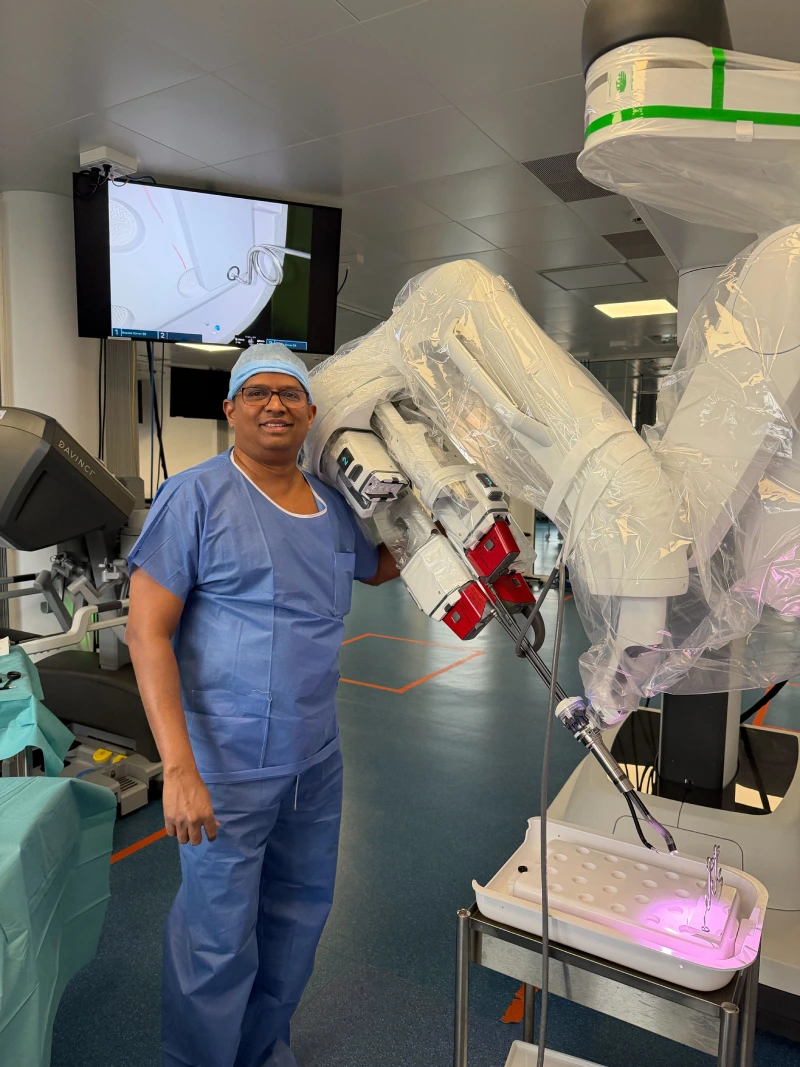
Single-port robotic surgery is performed using a robotic platform designed specifically to operate through one small incision, typically measuring around two and a half to three centimetres. Through that single access point, the system deploys a fully articulating three-dimensional high-definition camera together with three miniature robotic instruments, each equipped with joints that allow it to bend and rotate beyond the limits of the human hand. The surgeon controls every movement from a console within the operating theatre, viewing the anatomy in magnified 3D detail while the system translates each hand movement into precise, tremor-free motion inside the body. It is important to understand that the robot does not operate independently at any stage; it is an extension of the surgeon’s hands, refined to a level of accuracy that conventional instruments cannot match. Earlier attempts at single-incision surgery using standard keyhole instruments were hampered by straight instruments clashing through a single access point. The single-port robotic platform was engineered to solve precisely that problem, restoring the natural working geometry surgeons rely on while crossing the abdominal wall at only one point.
Why Patients Are Choosing the Single-Port Approach
The appeal of single-port robotic surgery rests on a simple principle: achieving the same proven operation through less disruption to the body. Because only one point of the abdominal wall is crossed, rather than three or four, many patients experience less postoperative discomfort and require only simple pain relief in the days following their procedure. The single incision is usually concealed within the natural folds of the umbilicus, meaning that once healed, the scar is often barely visible at all — a meaningful consideration for many patients who would otherwise carry several scars across the abdomen. The majority of single-port procedures are performed as day cases, allowing patients to return home the same evening, and most people find themselves back at desk-based work within about a week. Crucially, none of the established advantages of robotic surgery are sacrificed. The magnified three-dimensional vision, the fine instrument control, and the meticulous handling of delicate tissue all remain fully intact. The difference lies simply in how the operation begins: through one hidden incision rather than several.
Single-Port Robotic Gallbladder Surgery
Gallbladder removal, known as cholecystectomy, is one of the most frequently performed operations in the United Kingdom, most commonly for painful gallstones, inflammation of the gallbladder, or biliary colic. A conventional keyhole cholecystectomy involves four separate incisions across the abdomen. With the single-port robotic approach offered by Mr Ramar, the entire gallbladder is dissected free and removed through one small incision placed within the belly button. Under general anaesthetic, the single port is positioned and the camera and instruments deployed. The critical structures — the cystic duct and cystic artery — are identified under magnified three-dimensional vision and carefully dissected to achieve the internationally recognised standard for safe gallbladder surgery known as the critical view of safety. Once these structures are securely controlled, the gallbladder is separated from the liver, placed within a retrieval bag, and removed through the same single incision, which is then closed with dissolving sutures beneath the skin. The operation typically takes under an hour, and most patients go home the same day. Within a few months, many find there is little visible evidence that they had surgery at all. Further details can be found on the single-port robotic gallbladder surgery page.
Single-Port Robotic Inguinal Hernia Repair
An inguinal hernia — a bulge in the groin caused by tissue pushing through a weakness in the abdominal wall — is among the most common conditions treated by Mr Ramar. Repair involves returning the herniated tissue to its proper position and reinforcing the weakened area with a supportive mesh. Mr Ramar is one of few surgeons in the United Kingdom currently performing single-port robotic inguinal hernia repair, in which the entire operation is carried out through one small incision at the umbilicus, well away from the groin itself. Working through this single access point, he develops the natural plane behind the abdominal muscles, gently reduces the hernia while protecting the delicate structures of the groin, and places a mesh flat across the entire groin region. Covering not only the visible hernia but all potential hernia sites in this way is central to keeping recurrence rates low. The mesh is typically held in position by the anatomy itself, usually without tacks or staples, which is one of the reasons rates of chronic groin pain are low with this approach. Where a patient has hernias on both sides, both can be repaired through the same single incision — one of the situations in which the single-port technique is particularly elegant. Most patients walk comfortably the same evening, return home as day cases, and resume desk-based work within about a week, with heavy lifting restricted for a short period while the repair matures. Further details are available on the single-port robotic hernia surgery page.
How Single-Port Compares with Conventional Keyhole Surgery
Conventional laparoscopic surgery remains a safe and well-established option, and it is important to say so plainly. The advantage of the single-port robotic approach lies not in replacing what works, but in refining it. Where keyhole surgery uses three or four incisions and standard two-dimensional vision, the single-port platform delivers magnified three-dimensional vision and fully wristed instruments through one concealed incision. For some patients — for example, those with severe acute inflammation, extensive previous abdominal surgery, or particular anatomical considerations — a multiport robotic approach may be the safer and more appropriate choice. Because Mr Ramar’s practice is built entirely around robotic surgery, spanning both single-port and multiport platforms, the approach is always matched to the patient rather than the other way around. Suitability is assessed individually at consultation, with imaging reviewed and every option discussed openly.
Conclusion
Single-port robotic surgery represents the natural evolution of minimally invasive surgery: the same proven operations for gallbladder disease and inguinal hernia, performed with enhanced precision through a single hidden incision. For patients, the practical benefits are tangible — less disruption to the abdominal wall, reduced postoperative discomfort, a barely visible scar, and a swift return to normal life, typically as a day case. As one of the very few surgeons in the United Kingdom offering single-port robotic gallbladder and hernia surgery, Mr Sasindran Ramar provides patients in London with access to the most advanced surgical platform available, backed by a practice dedicated exclusively to robotic techniques.
If you have been diagnosed with gallstones or a groin hernia and would like to explore whether single-port robotic surgery is right for you, schedule a consultation with Mr Ramar today to discuss your symptoms and treatment options in detail.
Frequently Asked Questions (FAQs)
Is single-port robotic surgery safe?
Yes. The operation performed inside the body is the same proven procedure as conventional surgery, carried out with enhanced vision and instrument control. As with any operation, there are risks, and these are discussed fully and openly at consultation.
Does the robot perform the surgery itself?
No. Mr Ramar performs every part of the operation. The robotic system translates his hand movements into precise motion through the single port and has no independent function of its own.
Will I be left with a visible scar?
The single incision is usually concealed within or beside the belly button. Once fully healed, most patients find the scar is barely noticeable, and many report little visible evidence of surgery within a few months.
Am I suitable for the single-port approach?
Most patients requiring elective gallbladder removal or inguinal hernia repair are candidates. Factors such as previous abdominal surgery, severe inflammation, or individual anatomy occasionally make a multiport robotic approach the safer choice, and this is assessed at consultation.
Is single-port robotic surgery covered by private medical insurance?
Single-port robotic gallbladder and hernia surgery is recognised by major insurers under the standard procedure codes for cholecystectomy and hernia repair. Self-pay packages are also available, and the team can guide you through both routes.